
← Back to Insights

The Evolution of Marketing Operations

Why it has become one of marketing's most strategic functions.

Curved staircase in cream and violet tones, evoking the winding path of marketing operations maturity

Fifteen years ago, marketing lived inside its own walls. Campaigns were planned, emails were sent, leads were handed off to sales, and reports were created after the fact.

Today, marketing touches nearly every function in a business. Success depends less on how well each team performs individually and more on how well they operate together.

Marketing Operations didn't just evolve. It became the connective tissue that makes modern marketing possible.

The Evolution of Marketing

(and marketing operations right along with it)

Era one
Marketing as a Department
~2005
Marketing was a function unto itself. Campaigns were planned and executed within marketing, using a small stack of tools. Success was measured in leads and campaign performance.
Era two
Marketing as an Ecosystem
~2010–2015
Digital transformation expanded channels, data sources, and stakeholders. Marketing started working more closely with sales, IT, and product.
Era three
Marketing as a Revenue Engine
~2016–2020
Marketing became directly accountable for pipeline, revenue, and customer lifecycle. Data and technology scaled exponentially.

From Linear to Connected

The biggest shift in marketing over the past fifteen years isn't a channel or a platform. It's the shape of the customer relationship itself.

The old model was a funnel: campaign, leads, sales, report. Linear, one directional, done the moment the deal closed.

The model that replaced it is a loop. Customers move through discover, evaluate, buy, adopt and onboard, grow, and advocate, and then it starts again. There's no finish line anymore. Every stage feeds the next one.
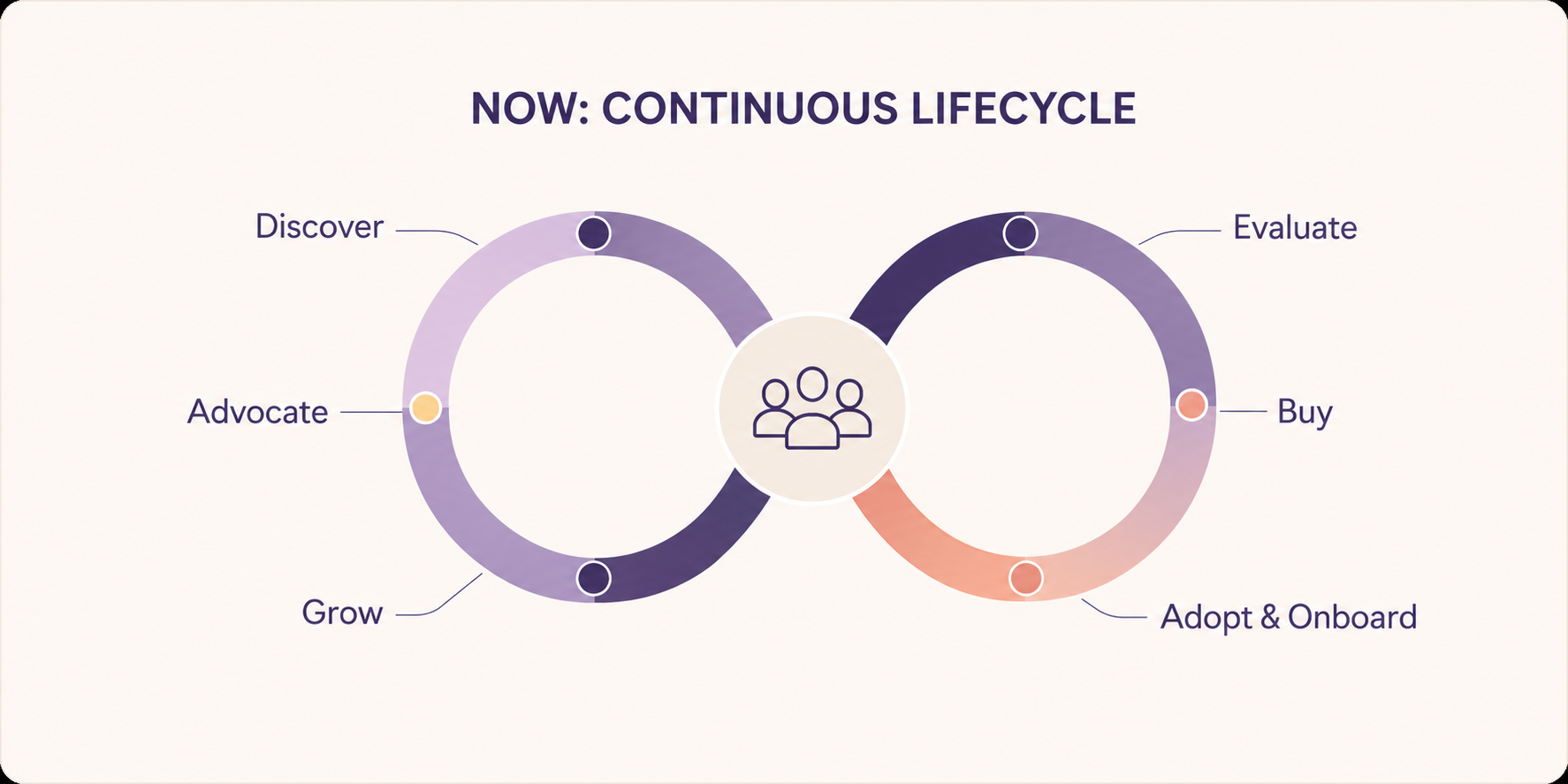
Infinity loop diagram showing the continuous customer lifecycle: discover, evaluate, buy, adopt and onboard, grow, advocate

What Changed in the Work Itself

It's not just the title that changed. The work underneath it did too.

A campaign request used to mean "send this email." Now it involves audience logic, consent, segmentation, lifecycle stage, attribution, routing, reporting, and follow-up.

A report used to mean performance tracking. Now it has to answer whether the underlying business process is actually working.

Automation used to mean efficiency. Now it requires governance, ownership, failure paths, and cross-functional agreement before it ever ships.

Data quality used to be a cleanup task somebody got to eventually. Now it's a revenue issue, a customer experience issue, and a decision-making issue.

AI does not reduce the need for operations, whatever the vendor decks promise. It increases the need for process clarity, source of truth discipline, and human judgment.

What This Means for Marketing Operations Today

The scope of the role expanded, and the impact multiplied right along with it.

It used to mean owning the marketing automation platform, building campaigns, managing data lists, creating reports, supporting the rest of marketing, and responding to requests as they came in.

Now it means designing the operating model, connecting teams and data, driving strategy and execution, enabling AI and automation responsibly, measuring business impact, and leading cross-functional change.

That's not a bigger version of the old job. It's a different job.

The Bottom Line

The evolution of Marketing Operations wasn't driven by technology. Technology accelerated it. The real driver was that marketing itself changed.

As marketing became more connected, more measurable, more digital, and more accountable to revenue, someone had to design the operating model behind it. That's why today's Marketing Operations leaders aren't just operating marketing. They're designing how modern marketing works.

Want to talk through how this applies to your organization?

Book a 30-Min Call